Skills intelligence is when companies use artificial intelligence (AI) to analyze their people data, understand which skills they have now and will need later, and make better talent decisions. Leveraging skills data is more important than ever, thanks to the conditions of today’s labor market:
- The World Economic Forum predicts that 39% of core worker skills will become outdated by 2030.
- SHRM research shows that the average time-to-fill is around 44 days, with some roles taking more than 60 days to fill.
- Replacing a bad hire costs between 50% and 4x the employee’s salary, including recruiting and lost productivity.
Taking a skills-based approach to the hiring process can help your recruiting team find great candidates you might have otherwise missed. Keep reading to learn practical ways to use skills intelligence to focus on what really predicts success so you can choose the right candidate, again and again.
What Is Skills Intelligence in Recruiting?
Skills intelligence is the foundation of skills-based talent management strategies — strategies based on your real people data, not guesswork. It’s a continuous loop: AI analyzes existing employee performance, learning records, and project outcomes to build verified employee skills profiles. Those profiles become your benchmark for what success looks like in each role, helping you screen, source, and hire with confidence.
Traditional hiring leans on résumés and subjective interviews. Skills-based hiring, on the other hand, relies on data. Here’s how it works in practice:
- Build skills profiles for roles using data from your high-performer data to identify what skills actually drive success.
- Score candidates on those skills. Use assessments, verified work samples, and AI analysis to rank applicants based on capability.
- Learn and improve. Track which skills predicted strong performance and refine your models for the next hire.
Hiring practices that use skills intelligence have many benefits for recruiters. They reduce bias by focusing on verified abilities and facilitate faster hiring since you can spot the best candidates quickly. Skills-first hiring even enables your team to predict on-the-job performance by matching candidates to proven success factors.
You can implement skills-based hiring at your org with these actionable tips. The first step — and the foundation of skills intelligence — is defining your roles in terms of skills, not just credentials.
Tip 1: Set the Foundation for Skills‑Based Sourcing
When you shift your focus from job titles and college degrees to the specific skills needed for success in each role, hiring gets more accurate. Sticking to traditional job requirements can limit your options and cause you to miss out on a great candidate.
Today, 70% of companies use skills-based hiring — and with good reason. Skills-first recruitment can yield 16x more qualified candidates in the U.S., dramatically expanding your talent pool.
Work closely with hiring managers to define five to ten critical skills for each role, separate must-haves from nice-to-haves, and challenge unnecessary credential requirements. You’ll be able to source more objectively and efficiently, laying a foundation for smarter candidate searches in the next step.
Tip 2: Use a Skills Taxonomy To Build Better Searches
Using a skills taxonomy means you can connect candidates’ related abilities to the skills your roles require, going beyond titles to find top talent. Standardizing key skills makes your searches broader and more accurate, so it’s no surprise that 81% of companies use skills in job descriptions and 65% for screening.
Map out core and adjacent skills, including technical and soft skills, for each role and update your list with input from learning and development (L&D) and hiring managers. This way, you won’t overlook qualified candidates.
Tip 3: Use AI-Powered Skills Inference To Uncover Hidden Candidates
Great candidates often don't list every relevant skill on their resume. Skills inference uses AI to spot them from work history and projects, surfacing talent you'd otherwise miss. When your applicant tracking system (ATS) or talent platform can read between the lines, it’s easier to spot adjacent skills that translate into your open roles. 94% of organizations say skills-based hiring beats resumes for predicting success.
You can take these steps to put skills inference to work:
- Enable AI skills matching in your ATS.
- Evaluate candidates with high skills/low title matches to weed out those that aren’t a good fit.
- Verify skills with short assessments and structured interviews.
Tip 4: Build Skills-First Talent Profiles
Even with better sourcing, it’s still hard to compare candidates fairly if their information is scattered across resumes, notes, and emails. Skills‑rich talent profiles pull everything into one view — skills, work experience, portfolios, skills assessments — ideally in your ATS or talent management platform.
When you review skills before company names or schools, you’re comparing candidates on what they can actually do. Employers using skills‑based hiring see big benefits, including a 74% decrease in cost per hire and 88% fewer mis‑hires over time.
Tip 5: Use Skills Intelligence for Faster Time‑to‑Fill
Skills‑based hiring improves match quality and helps you find them faster. Organizing your searches, profiles, and talent pools around skills means it takes less time to build a solid candidate slate.
Instead of starting from scratch on every req, you can build outreach lists using skills‑based matching and re‑engage candidates whose skills now fit new openings. Over time, evergreen talent pools organized by skill clusters (like “Python + data” or “frontline leadership”) give you a head start on every search and a direct path to lower time‑to‑fill.
Tip 6: Leverage Skills‑First Practices To Support Diversity
Skills‑based hiring and skills intelligence help you build more inclusive pipelines. When you focus on real skills instead of degrees, employers, or linear career paths, you widen the funnel without lowering the bar.
You can make simple changes to open the door to qualified candidates who might have been screened out before. Removing nonessential degree requirements, highlighting skills over credentials in your job ads, and considering candidates from adjacent industries can all help diversify your pipeline. To see if your changes are working, monitor the diversity of your skills‑based talent pools and shortlists.
Tip 7: Make Skills Intelligence Part of Your Weekly Routine
Skills intelligence delivers the most value when you make it part of your work week rather than a one-time project. You can do that by starting every new search with a quick skills review, checking skills‑based talent pools before posting externally, and looking at skills analytics regularly.
Capturing post‑hire feedback from hiring managers, like which skills really mattered and which were missing, helps you keep refining your profiles. And when you’re evaluating talent management software, look for platforms that bring skills taxonomy, skills inference, and talent profiles together in one place so you’re not stitching it all together manually.
Make Skills the Default Decision Layer
Recruiters are being asked to move faster, reduce mis‑hires, and support long‑term talent strategy — all in a market where skills are changing, and talent is hard to find. Skills‑based hiring and skills intelligence give you a way to meet those expectations.
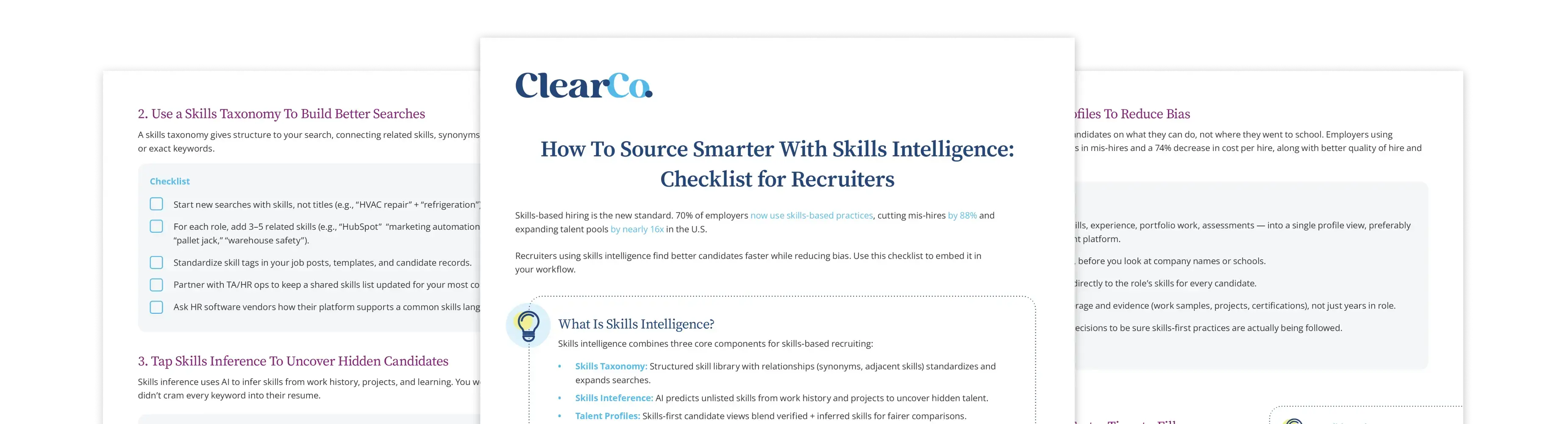
If you’re ready to put these ideas into action, we turned them into a practical resource you can use now. Download How To Source Smarter With Skills Intelligence: Checklist for Recruiters for quick steps you can plug into your next search — from defining skills for a role to using your ATS to find, shortlist, and re‑engage the right candidates.
.png)